
80 Facebook pages, one product
I pulled apart a brand that runs about 80 Facebook pages for one product. The lesson wasn’t about ads.
The brand is Hello Nancy. It sells one main product for $89 [C056]. I expected a clever ad account. What I found was a company that has worked out who its buyers are, one at a time, and built a different front door for each of them.
Ads run by the page called Hello Nancy
About 1 in 17 (137 of 2,360 in my sample). The rest ran under names like Hidden Bloom, Simply Bloom and She & Co.
Most of those ads don’t even send you to the store. 1,673 of them land on magazine-style sites and review blogs that run the store’s own tracking [C009, C026, C038, C069].
One page per buyer
Here’s the part that stuck with me. They don’t write one sales page. They write one page for each kind of buyer, and each page starts from that buyer’s situation.
| Who it’s for | The angle |
|---|---|
| Bored in a relationship | a “best of” list that promises some excitement |
| A single mum with no time | “I tried five, here’s the only one I still use” |
| A skeptic who wants proof | “I spent $1,200 testing 18 of them. Here’s my top 10” |
| A woman going through menopause | a line about how fast this would be solved if it were men’s problem |
| Already owns a competitor | “loved yours? These go further” |
| Looking for a discount | “discount code 2026: save 69% today” |
| Worried it’s a scam | “Is Hello Nancy legit?” |
Read the right column. The product is barely in it. Each buyer gets met at the thought they already had before the ad showed up [C073, C074, C075, C029, C076, C077, C078].
The menopause line alone ran on 244 ads, in 27 versions [C029].
The first page only earns the click
The page an ad sends you to is tiny. A headline, an image, a button. 111 of them, with a median of 58 words [C015].
It isn’t trying to sell. It’s trying to get you to the next page, a long article that does the selling. One of these short pages took 344 of the ads I saw on its own [C014].
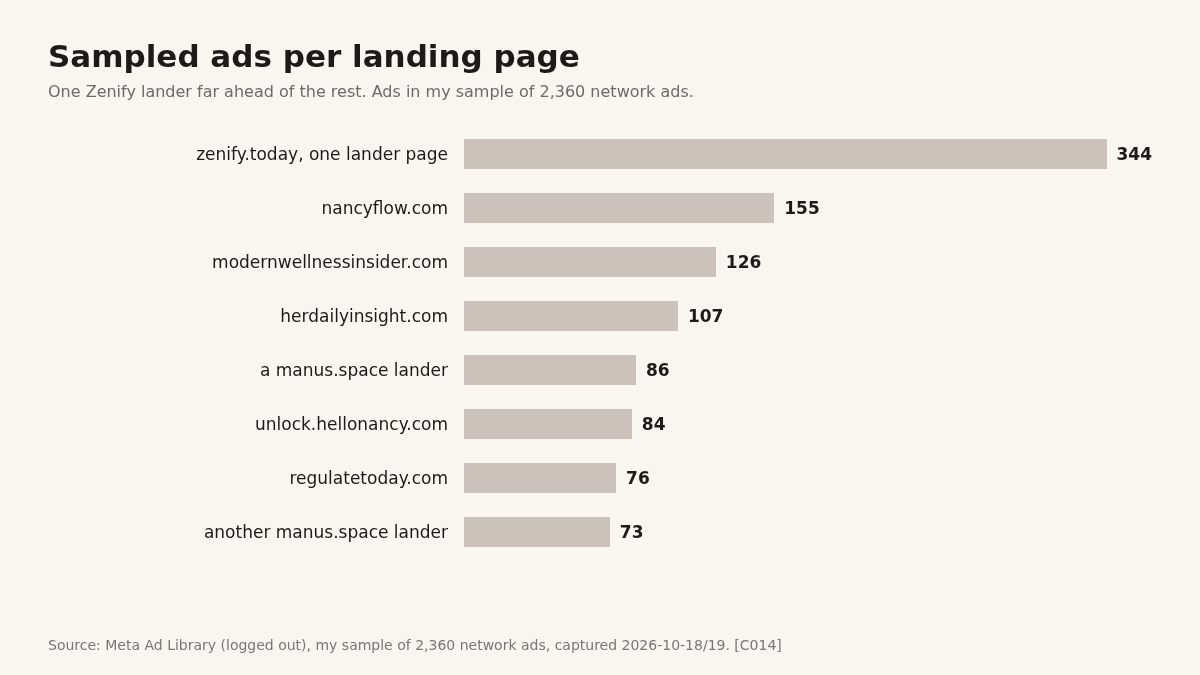 Source: Meta Ad Library (logged out), my sample of 2,360 network ads, captured 2026-10-18/19
They copy what already works
Their newest site has page templates in its code named after other brands’ funnels: “Pick your pairing (Seed picker)”, “Today’s offer PDP (Magic Mind)”, and five more [C020].
So they don’t invent a sales page. They take one that’s already selling for someone else, rebuild it as a template and drop their product in. Honestly, I think that template library is worth more than any single ad.
They let the buyers pick
307 of their 494 active ads started in the last 30 days. And 51 had been running for six months or more, the longest for 332 days [C023, C024].
That’s the whole system. Lots of new tries, and the money follows whatever’s still working months later.
What I’m taking from it
This one landed close to home. I build: design, features, quality. Then I wonder why nobody shows up, and the few who do get lost in features nobody asked for.
Their numbers didn’t impress me. Their order of work did. They start from the buyer and work back to the product. I start from the product and hope the buyer finds it.
And my own numbers say the same thing. On one of my sites, two posts get most of the clicks, and I’d been writing batches of new ones on other topics. Another has thousands of pages and, last month, 25 visitors who came from another site.
So, what I’m taking:
What I’d leave out
To be clear, not all of it is worth copying. Their own numbers don’t agree: their reviews page says “4.7” at the top, and the star breakdown further down the same page averages 3.95 [C017, C052]. Review counts range from 11,276 to “22,000+” depending on the page [C047, C048, C050, C051]. If you build several doors, keep one source of truth for every number behind them.
Every number here has a source. The full list, how I checked it and what I got wrong in my first draft are on the resources page.
If this is the kind of thing your launch needs, a page per buyer instead of one more feature, that’s the work I do: here’s how to hire me. And happy to answer questions.
Related:
Captured 2026-10-18/19. Ad networks change weekly; re-check 2027-01-19.